

The listing of SpaceX on the stock exchange ranked among the largest IPOs in the history of financial markets. The originally planned volume of USD 75 billion increased to USD 85.7 billion after the exercise of the greenshoe option with the participation of Goldman Sachs and Morgan Stanley. Strong investor demand enabled the additional sale of 83.3 million shares and expanded the capital that the company can use to finance the next phase of development.
Market debut and new valuation
The offering price was set at USD 135 per share before trading began. During Friday’s debut, SpaceX shares rose by approximately 19% and closed the first trading day at around USD 161.*
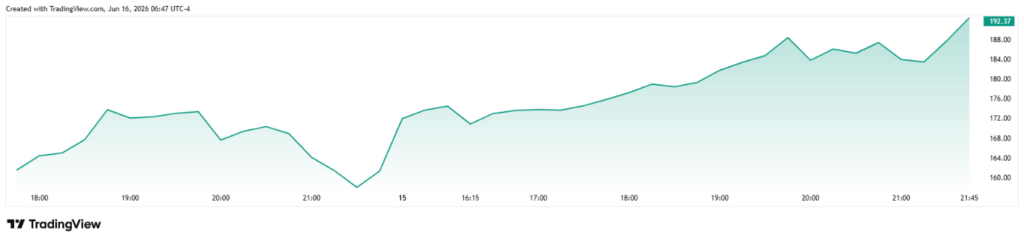
Performance of SpaceX’s share price since its stock market debut*
Strong growth momentum continued on Monday morning, when at the opening of the first full trading day the price of SpaceX shares strengthened by a further more than 7%.* According to official market data, SpaceX shares recorded an overall increase of 19.27% on that day.* This price growth also increased the company’s total market capitalization above the threshold of USD 2 trillion.*
Strategic motives for entering the stock market
The decision to transform SpaceX into a publicly traded company had long been expected. According to available information, the company’s founder Elon Musk justified it by the need to secure capital for the upcoming investment-intensive phase of growth.
The company is no longer only in the stage of early technology development, but is moving into a phase of building extensive global and extraterrestrial infrastructure. According to the stated reasoning, these capital needs might not be possible to cover over the long term solely through private investment rounds or internal cash flow from existing contracts. Access to public equity markets can therefore provide the company with a broader source of liquidity needed to implement its strategic goals.
Technological allocation of the capital raised
The majority of the newly raised tens of billions of USD is expected to be directed toward two core pillars of SpaceX’s business. The first is the Starship rocket system, which is currently the largest and most powerful space transportation vehicle ever built by humanity. Although the system is still in the testing phase and previous flights mainly carried satellite mock-ups, the funds raised are intended to accelerate its full reusability and the launch of commercial operations.
The second strategic objective is the massive expansion of the Starlink satellite network. The capital is intended to enable the mass production and launch of a new generation of satellites designated V3. According to the company’s plans, this new constellation is expected to increase transmission capacity, reduce latency, and expand the availability of satellite internet globally.
Orbital data centers and chip independence
In addition to developing existing programs, SpaceX plans to invest in entirely new, as yet unverified technological segments. The most ambitious of these is the construction and operation of orbital data centers integrated directly with elements of artificial intelligence. Elon Musk presents this concept as an innovative solution to the global energy crisis, since data centers in space would be powered by continuous solar radiation without burdening the terrestrial electricity grid.
However, experts warn that this technology brings significant technical and environmental risks. At the same time, SpaceX plans to build a large chip factory in the state of Texas in cooperation with the carmaker Tesla and the technology group Intel. According to available information, this strategic alliance is intended to provide the company with hardware independence in the production of semiconductors for the needs of AI and space infrastructure.
Fundamental analysis of risk factors
Despite significant investor interest, a look at SpaceX’s financial statements reveals major risk factors. Last year, the company reported a net loss of USD 4.9 billion, while cumulative losses since its founding have already exceeded USD 41 billion. However, the current market valuation represents 112 times last year’s revenue.
Compared with traditional technology “megacaps,” the company generates only a fraction of their actual revenues. All key projects, such as commercial Starship flights, space data centers, or the construction of a semiconductor factory, are capital-intensive and associated with a high degree of technological uncertainty. An extension of the testing phase, a launch failure, or a delay in commercial deployment may subsequently negatively affect the financial stability of the company.
Conclusion and investment outlook
The stock market story of SpaceX shows that investors value above all the company’s future potential and the scale of its strategic plans. However, the success of this offering will depend in the medium term on how quickly management can transform technical innovations into stable and profitable cash flows.[1]
* Data relating to the past are not a guarantee of future returns.
[1] Forward-looking statements represent assumptions and current expectations that may not be accurate, or are based on the current economic environment, which may change. These statements do not guarantee future performance. Forward-looking statements by their nature involve risk and uncertainty because they relate to future events and circumstances that cannot be predicted, and actual developments and results may differ materially from the results expressed or implied in any forward-looking statements.
Warning! This marketing material is not and must not be understood as investment advice. Data relating to the past are not a guarantee of future returns. Investing in a foreign currency may affect returns due to fluctuations. All securities transactions may lead to both gains and losses. Forward-looking statements represent assumptions and current expectations that may not be accurate, or are based on the current economic environment, which may change. These statements do not guarantee future performance. CAPITAL MARKETS, o.c.p., a.s. is an entity regulated by the National Bank of Slovakia.
Sources:
https://www.cnbc.com/2026/06/15/spacex-ipo-spcx-greenshoe-overallotment.html
https://www.cnbc.com/2026/06/12/spacex-ipo-spcx-live-updates.html
Mgr. Anna Šuhajdová, Chair of the Board of Directors of CAPITAL MARKETS, o.c.p., a.s.
Sponsored Content
Photo source: Adobe Stock